Email: me@tatjanavehovec.me
Linkedin: linkedin.com/in/tatjanavehovec

Post-sale customer marketing is the big part of your revenue strategy.
The contract is signed. The CRM is updated. Marketing is already thinking about the next logo.
And somewhere in your account base, a customer you spent fourteen months and a small fortune acquiring is waiting to find out if you’re actually as good as you were during the sales process.
Spoiler: most vendors aren’t.
The contract is signed.
The champagne is warm, the CRM is updated, and your BDR just got a Slack emoji from the CEO.
Everyone is very pleased with themselves.
And somewhere in a server room, the customer you just spent fourteen months and a small fortune acquiring is waiting for someone, anyone, to make them feel like the relationship has actually started.
They’re still waiting.
Most companies treat the closed-won notification as the end of marketing’s job.
Demand gen hands the account to customer success, customer success runs the onboarding checklist, and marketing goes back to filling the top of the funnel with more expensive strangers.
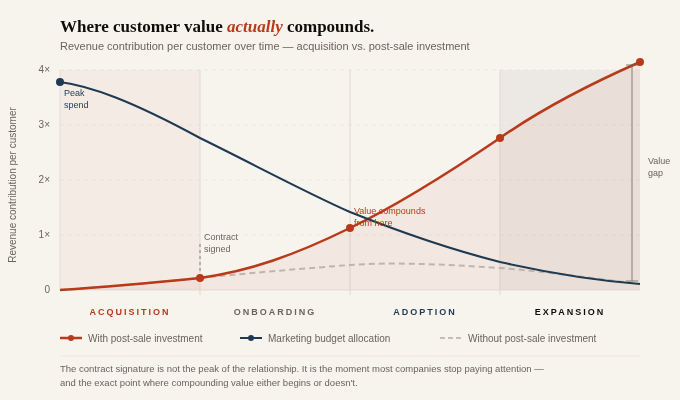
Customer success owns the renewal conversation. Sales owns the upsell call. Marketing owns the next logo. And the actual human being who just committed significant budget and significant political capital to your product, who had to convince their CTO, survive the procurement process, and sit through your implementation kickoff, is being managed by a shared OneDrive folder and a quarterly business review template.
This is not a customer experience problem. I think it’s a revenue architecture problem.
Let me be specific about what not being active in post-sales life costs, because “customer retention is important” is the kind of sentence that we all agree with and rarely act on.
The average B2B company spends five to seven times more acquiring a customer than retaining one.
Let that sink in.
The average net revenue retention in SaaS, meaning the revenue you keep and expand from existing accounts, is the single most predictive metric for long-term company health. More predictive than new logo growth. More predictive than pipeline velocity. More predictive than your CAC payback period, which your CFO definitely has opinions about.
And yet.
Marketing headcount, budget, and creative energy is overwhelmingly allocated to acquisition. Post-sale communication is mostly automated. Post-sale content is mostly product documentation. Post-sale strategy is mostly “let’s get a case study.”
The case study is for your next prospect. What are you doing for the customer you already have?
The B2B version of the jacket problem is subtler but more expensive.
Your customer bought your product because they believed it would solve a specific problem. Six months in, they are probably using 40% of its capability. They have not touched the features that would make them impossible to churn. They have not connected the dots between what your product does and the business outcome their CFO cares about. They have not become the internal champion who will defend the renewal, expand the contract, and take you with them when they move to their next company.
They bought the jacket. You never taught them how to wear it.
So when renewal comes around and procurement asks whether they can find a cheaper alternative, your customer doesn’t have a strong answer. Because you never gave them the language, the evidence, or the internal narrative to defend it.
You lost a renewal that was already yours. You just forgot to close it.
Stop treating post-sale as a cost centre and start treating it as a revenue motion. That means owning it strategically, not just operationally. Customer marketing is not a nice-to-have for companies with mature brand teams. It is the mechanism by which you turn a transaction into a revenue line that compounds.
Your customer needs to be able to articulate the value of what they bought. To their team, to their leadership, and eventually to their peers at industry events. That articulation does not emerge naturally from a product walkthrough. It has to be architected. What is the story they should be telling about what changed since they implemented your product? Build that story with them, in the first ninety days, before the initial enthusiasm fades and the internal sceptics get louder.
The worst expansion conversations happen when sales calls out of nowhere fourteen months in to pitch an additional module. The best ones happen because the customer has been experiencing incremental value. Through content, through proactive insight, through a community of peers using the product. And the commercial conversation is a logical next step rather than an interruption. Marketing owns the conditions that make expansion feel obvious. Sales closes it.
In B2B, your existing customers are the most credible marketing channel you have. Actual humans who will take a call, share a conference stage with you, and tell their peers honestly what the implementation was like.
That relationship is built over months of genuine investment in the customer’s success. It cannot be manufactured at the end of the first contract term when you need a reference for a hot prospect.
It is either already there or it isn’t.
The funnel metaphor has always been slightly wrong, but nowhere more wrong than here.
A funnel ends. Revenue retention doesn’t. The customer who signs this year is either becoming more embedded in your product, more vocal in your market, and more valuable to your commercial model, or they are evaluating your competitors while your demand gen team is running ads at people who have never heard of you.
Both things are happening right now, in your existing account base.
The question is which one you’re paying attention to.
The B2C version of this argument is funnier. It involves a jacket and a 2am text. If you want the consumer marketing take, that one’s here too. Same point, different wardrobe.