Email: me@tatjanavehovec.me
Linkedin: linkedin.com/in/tatjanavehovec

Bob Moesta, collaborator to Harvard Business School professor Clayton Christensen, was there because McDonald’s had a precise commercial problem: milkshake sales were flat. The company had done the research, surveyed the customers, improved the product based on what people said they wanted. Nothing moved.
So Moesta stood in a restaurant and watched. Who bought milkshakes. When. What they were wearing. Whether they came alone. What else was in their hands. Then he came back the next morning and asked the people leaving with milkshakes a single question: what were you trying to get done when you decided to buy that?
What came back changed how Christensen taught marketing at Harvard for the next two decades.
“What causes us to buy products and services is the stuff that happens to us all day, every day. We all have jobs we need to do that arise in our day-to-day lives, and when we do, we hire products or services to get these jobs done.” That is Christensen, from Competing Against Luck (2016). The milkshake is where that principle became impossible to ignore.
I like the story! I don’t like milkshakes.
Nearly half of all milkshakes were sold before 8:30 in the morning. One customer at a time. Always took it to the car. Never sat down, never ordered anything else.
When Moesta asked why, they all said roughly the same thing. Long drive to work. Boring. One hand on the wheel, nothing in the other. Not hungry yet, but hungry by 10am. They needed something that would last the commute, keep the spare hand occupied, and stay contained enough to survive the journey without ending up on a work shirt. The milkshake, pulled slowly through a thin straw, lasted 45 minutes. It did the job.
So the milkshake was competing with the radio, the commute itself, and the hunger that was coming. No survey found that. No demographic profile predicted it. Moesta found it by watching, then asking the right question.
A smaller group bought milkshakes in the afternoon. These were parents. The job was completely different: a moment with their child, a small treat at the end of a long day. And in that context, thick was wrong! A shake that took 40 minutes to finish through a straw was 40 minutes of a child struggling, not 40 minutes together.
Same product. Two completely different jobs. Two completely different versions of what good looks like.
McDonald’s had been optimising for a product. The answer was to optimise for a job.
Moesta spent 18 hours in a McDonald’s outlet and found that nearly half of all milkshakes were sold before 8:30 in the morning, consumed alone, in a car, on a commute. The banana, the bagel, and the Snickers bar were the real competition.
[Source: Clayton Christensen, “Integrating Around the Job to be Done,” Harvard Business School, 2006]
Christensen’s research showed that between 75 and 85 percent of all new products fail financially. His explanation was consistent across all of them: they were built and marketed around what the product was, not around the job customers needed it to do.
The job is also what tells you who you are actually competing against. And in B2B, the real competition is almost never the vendor on the other shortlist.
The morning milkshake was not competing with a Frappuccino. It was competing with a banana, a Snickers, and an empty hand on a long drive.
A B2B project management platform is not competing with Monday or Asana. It is competing with the spreadsheet that Karen in operations has maintained for four years and knows better than anyone, and with the inertia of a team that has learned to work around the problem.
An enterprise CRM is not competing with Salesforce or HubSpot. It is competing with the gut instinct of a sales director who has been in the business for fifteen years and genuinely believes she does not need a system to tell her what her pipeline looks like.
The actual competitor is almost always: doing nothing, a workaround that is already working well enough, or a different category product that does the same job more cheaply or with less friction. Price your value proposition against that. Build your messaging to replace that.
We identify three layers to every job a customer is trying to do. You cannot ignore any one of them.
Stay occupied during a boring commute. Know what my team is doing without having to ask everyone individually. Never be stranded at sea because of a battery failure. This is the layer most marketing gets right, and it is also the most easily replicated by competitors, because it maps directly to product features.
Or stop feeling, as a result of hiring your product. The commuter wants stimulation, not hunger, not boredom. The parent wants relief from guilt. The B2B buyer does not want confidence in the abstract: they want to stop feeling exposed before they walk into a room full of people who will ask hard questions. Emotional jobs are almost never written into a brief. They are almost always present in the buying decision.
The procurement manager wants to look rigorous. The technical lead wants to look like someone who is not fooled by vendors. The CMO wants to look bold, not reckless. If your product helps someone look good internally, to their team, to their board, say so directly. Most B2B messaging pretends this dimension does not exist. The buyer does not.
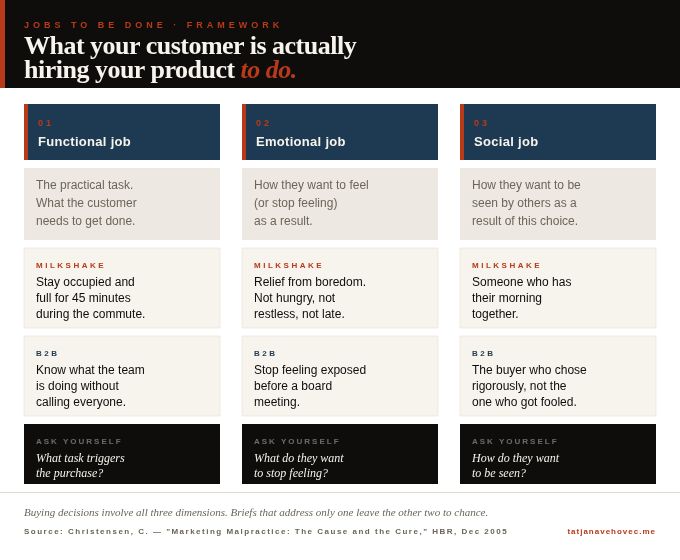
In B2C, you are usually talking to one person who uses the product and decides to buy it. The job is relatively unified, even if it has all three dimensions.
In B2B, you have what JTBD practitioners call three distinct customer roles. The Job Executor: the person who will actually use the product day to day. The Product Lifecycle Support Team: the people who have to install, maintain, and live with your product after the sale, IT, legal, procurement, security. The Buyer: the person who makes the commercial decision, often without using the product themselves.
Each of them has a different job. Each of them has a different definition of progress. Each of them needs a different message. And if your GTM messaging was written for only one of them, which statistically it was, you are leaving two thirds of the buying committee unmoved.
This is how B2B deals stall. When message for the CFO and the message for the technical lead are the same document, and neither of them can find their own job in it.
Understanding what job each stakeholder is trying to do, functionally, emotionally, and socially, is not a content production problem. It is a strategic architecture problem. It belongs at the beginning of the brief, before the first word is written.
You do not need a six-week research programme to apply this. Moesta’s methodology, built from the same process used on the McDonald’s study and published in his book Demand-Side Sales 101 (2020), identifies what he calls the “switching moment“: the specific circumstance that caused someone to decide they needed something at all.
Answer these three questions:
First: what is the specific circumstance that makes someone need what you sell? A moment. Tuesday morning, two days before a board presentation, realising the pipeline numbers in the deck might not hold up under questioning. That is the person you are writing for. Write to that moment.
Second: what are you actually competing against? For most B2B products, the real competition is a spreadsheet someone has maintained for twelve years and trusts completely, or the internal argument required to justify a budget when the free alternative works well enough. That is what your messaging needs to displace.
Third: what does progress look like for each person in the buying committee? The person who will use the product every day wants something different from the person signing the purchase order, who wants something different from the IT team inheriting it. Each of them has a job. Each of them needs to find themselves in your messaging.
Answer those three questions and the brief writes itself.
People hire products to make progress in a specific moment. They hired the milkshake to survive a commute. They hire your product to solve something real, in a specific set of circumstances, for reasons that have nothing to do with your feature list.
Your product is probably already good. The question is whether your messaging is even talking about the right job.
Christensen put it directly: “If we understand the job the customer is trying to do and develop a product that nails the job perfectly, then the probability that your innovation will be successful is improved in dramatic ways.”
Jobs to Be Done marketing asks these questions: good at what, for whom, in what exact moment, and compared to what alternative?
If you are building or fixing a marketing strategy and want a strategic second opinion, let’s talk. Or see how this thinking applies in practice in the work section.