Email: me@tatjanavehovec.me
Linkedin: linkedin.com/in/tatjanavehovec

What drives every purchase decision?
Every brief I have ever seen opens with the product.
Features, benefits, differentiators, the reason we are better than the competition. Pages of it.
And almost none of it answers the only question the buyer is actually asking, which is not “what does this do?” but “what does this remove from my life?”
Four things. That’s all anyone ever buys. And most marketing misses the primary one completely.
Here is a theory I have been stress-testing for years across industries, price points, and buyer types, from a €12 mascara to a €2 million enterprise software contract.
People always buy four things.
Time. Money. Status. Peace of mind.
That’s it. The entire commercial universe gets into four drivers. Your product, whatever it is, delivers one of them as its primary value, and the ones who buy it are the ones for whom that driver is currently the most urgent, the most personal, or the most professionally consequential.
Everything else, the features, the specs, the brand story, the gorgeous campaign, is the package. The four drivers are what’s inside.
I’ll prove it.
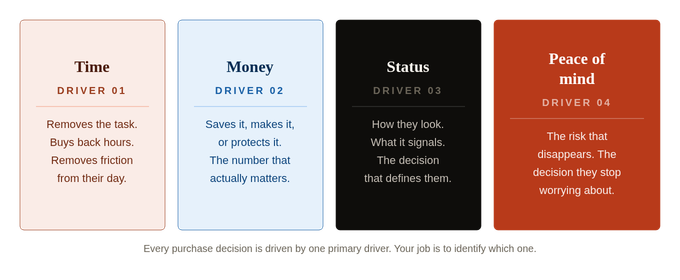
Time is the rarest resource and the one people are least honest about wanting. Nobody admits they bought the premium subscription because they couldn’t be bothered to do it manually. But they did. Time buyers are not lazy. They are prioritising, and they have decided that this task is not where their hours should go. The product that removes the task wins. Not the one that makes the task prettier.
Money is the most obvious driver and the most overused pitch. Every vendor thinks they have a money argument. Most of them have a time argument with a spreadsheet attached. A genuine money driver means the buyer’s primary motivation is financial return, saving it, making it, protecting it. The CFO evaluating your proposal. The procurement manager with a cost reduction mandate. The small business owner for whom every euro is a decision. These buyers want the number first. They will find the features later.
Status is the one marketers are most comfortable with in B2C and most embarrassed about in B2B, as though enterprise buyers are somehow above wanting to look good. They are not. The CTO who championed your implementation wants to be seen as the person who made the right call. The CMO who chose your agency wants their peers to ask who did that campaign. The CEO who bought the premium suite wants the logo on the slide at the board meeting. Status is not vanity. It is professional identity. And it closes more B2B deals than anyone will admit in a case study.
Peace of mind is the most undervalued driver in commercial strategy and the most powerful one in the room when it’s the primary need. Peace of mind buyers are not buying a product. They are buying the absence of a problem. The risk that disappears. The decision they no longer have to make. The thing they can stop worrying about at 2am. When someone is buying peace of mind, they do not need to be excited about your product. They need to trust it. Those are completely different conversations.
The skill is not knowing the four. It’s identifying the primary one.
This is where most marketing strategy gets confused.
Because the team understands their product so well, from the inside, that they pitch the driver they find most compelling, which is almost never the driver the buyer actually makes the purchase decision with.
The four drivers are not always mutually exclusive.
A good accountancy software saves money and time and gives the user peace of mind. A luxury car delivers status and, to a specific buyer, time (because the service is seamless and they never think about it).
But in every buying decision, one driver is primary. One is the thing that made this buyer open the tab, book the demo, pick up the phone.
Your job is to identify which one it is. For this buyer. In this moment. And lead with that.
Everything else is supporting evidence.
The first is in cosmetics.
There is an entire category of skincare and beauty brands sitting on one of the most powerful peace-of-mind propositions in consumer marketing: genuinely clean ingredients, no allergens, no compromises, results that don’t come with a risk attached. The “I have sensitive skin and I’ve tried everything and I just want something that works without punishing me for it” buyer is enormous, loyal, and chronically underserved.
These brands almost universally sell status instead.
The aesthetic packaging, the influencer partnerships, the “this is what the discerning woman chooses” positioning. Which works, for status buyers. But it completely abandons the peace-of-mind buyer who would pay a premium, never churn, and tell every person in their life about the brand that finally didn’t give them a reaction. That buyer isn’t looking for beautiful. They are looking for safe. And nobody is talking to them directly because the brand fell in love with its own visual identity.
The second is in B2B SaaS.
A software product that genuinely, measurably saves significant time, the kind of time that a CTO and their engineering team feel every single week, being sold primarily on price. In a meeting with a CTO.
Two things are wrong simultaneously.
The CTO does not own the price decision. That conversation belongs with the CFO or procurement. Bringing a cost-reduction argument to a CTO is not just the wrong message, it is the wrong room. CTOs are buying reliability, integration credibility, and the confidence that this will not blow up in their face six months post-implementation. That is peace of mind with technical specifications, and it matters more than you think. Research consistently shows that B2B buyers are significantly more emotionally connected to their vendors than consumers are to the brands they buy from. The stakes are higher, the career implications are real, and trust, not price, is what closes the room. Price is what you discuss after they’ve decided they want it.
One question. Ask it before you write a brief, design a campaign, or walk into a sales conversation.
What is this specific buyer most afraid of losing: time, money, status, or certainty?
Not what your product delivers. What they are afraid of losing.
Because buyers are not motivated by gain in the abstract. They are motivated by the specific, personal, sometimes slightly irrational thing they cannot afford to lose right now. The user three months from a fundraise is afraid of losing money and credibility simultaneously, that’s a money and status combination, and the primary driver shifts depending on which meeting you’re in. The operations director whose last software implementation was a disaster is afraid of losing their reputation for good decisions. That’s status dressed as peace of mind. The executive team that has been burned by a long implementation cycle is buying time, not features.
Read the fear. Pitch to the driver.
And if you’re not sure which one it is, ask. Directly. The best sales conversations I’ve been in or around are the ones where someone had the confidence to say: what would make this an obvious yes for you?
The answer will be time, money, status, or peace of mind. Every time. Without exception.
The next time someone asks you what your product does, resist the urge to describe it. Describe what it removes instead.
The anxiety. The manual process. The embarrassment of the wrong decision. The cost that compounds quietly in the background.
That’s what people buy.
Your product is just the mechanism.
The four drivers are not a framework to put in a deck. They are a diagnostic, for the brief you are about to write, the campaign you are about to approve, the sales conversation you are about to walk into.
Before any of that: one question. What is this specific buyer most afraid of losing?
Time. Money. Status. Peace of mind.
The answer is always one of those four. Your job is just to ask early enough to use it.